Monday, November 8, 2021

Dispelling myths about the 1965 Indo-Pakistan war

 The purpose of this post is not to advocate war. All issues between countries should be sorted peacefully, including India & Pakistan. War should be a last resort.

However, no matter how regretful the 1965 war was as well as other wars were, a common myth persists on it being a major loss for Pakistan as well as other wars. The purpose of this post is not to advocate further wars, but to dispel myths of previous wars. 

Some press publications from the 1965 war:


Indian tanks captured by Pakistani forces:


Pakistani troops advancing on the front lines:


Wednesday, October 13, 2021

Unforgettable tweet on the subcontinent before the so-called "'partition' of 'India'"

 An unforgettable tweet by an educated and well-informed Pakistani on twitter. Well done:


Friday, June 25, 2021

Quotes on Hindu and Hinduism

 “"Hinduism" is largely a fiction, formulated in the 18th and 19th centuries out of a multiplicity of sub-continental religions, and enthusiastically endorsed by Indian modernisers. Unlike Muslims, "Hindus" have tended to borrow more than reject, and it has now been reconfigured as a global rival to the big three monotheisms. In the process, it has abandoned the tradition of toleration which lie in its true origins.” -Pankaj Mishra

 "The term Hinduism ... [ was ] introduced in about 1830 AD by
British writers. " [Encyclopedia Britannica, 20 `Hinduism' 519 ]

"The term Hindu was first imposed on south Asian nations by the
Afghan dynasty of Ghori in the 12th century; this term was never
used in south Asia prior to the Muslim era and is not even found in
early (pre-12th century AD) Brahmanical or Buddhist texts. Such a
term and concept has no historical depth in any social, religious,
ethnic or national sense past the 12th century when Mohammed Ghori
for the first time named his conquered subjects Hindus." [G. Singh,
Sakasthan and India, Toronto, 1999, p. 20]

"Hinduism, as a faith, is vague, amorphous, many-sided, all things
to all men. It is hardly possible to define it, or indeed to say
definitely whether it is a religion or not, in the usual sense of
the word." [Jawaharlal Nehru, The Discovery of India, New Delhi,
1983, p.75]

"Frankly speaking, it is not possible to say definitely who is a
Hindu and what Hinduism is. These questions have been considered
again and again by eminent scholars, and so far no satisfactory
answer has been given." [Swami Dharma Theertha, History of Hindu
Imperialism, Madras, 1992, p. 178]

"Hinduism defies definition... It has no specific creed." [Khushwant
Singh, India: An Introduction, New Delhi, 1990, p. 19]

"The more Hinduism is considered, the more difficult it becomes to
define it in a single phrase... A Hindu may have any religious
belief or none." [Percival Spear, India: A Modern History, Michigan,
1961, p.40]

Friday, April 16, 2021

Quotes on the history of Lashkari or "urdu" -Pakistan's national language

 
 Note: India the historical region needs to be distinguished from the modern country founded in 1947 of a seperate geography taking up the name.

*"The very word Urdu came into being as the original Lashkari dialect, in other words, the language of the army."

-Geography of the South Asian Subcontinent: A Critical Approach

 “The Punjab presumably felt the impact of Persian before any other part of India, starting in the Ghaznavid period. Bailey believes that “the formation of Urdu began as soon as the Ghaznavi forces settled in Lahore in 1027”

-Literacy in the Persianate World: Writing and the Social Order

“As we have seen , Mahmud Shirani places the origin of Urdu in the eleventh century, relating it to the Ghaznavi rule over the Panjab”

- A House Divided: The Origin and Development of Hindi/Hindavi

Grahame Bailey , after analysing them , came to the conclusion that "the formation of Urdu began as soon as the Ghaznavi forces settled in Lahore , i . e . in 1027 ”

-Rise of Muslims in Indian Politics An Analysis of Developments from 1885 to 1906

“Mahmud Shirani places the origin of Urdu in the eleventh century, relating it to the Ghaznavi rule over the Punjab”.

- History of Printing and Publishing in India: Origins of printing and publishing in the Hindi heartland

“Urdu begins , as it must as a matter of commonsense have begun , as soon as the Ghaznavi armies got to Lahore in 1027 - and Lahore was nowhere near the area of Khari ( and still less that of Braj and Avadhi)”

- Central Asian Review Volume 15 1967

“The language in which these texts were written was similar to Urdu, which was to develop much later. The assertion is based on the premise that this early Urdu-like language was derived from Ghaznavid Persian”

- A Comprehensive History of Medieval India Twelfth to the Mid-eighteenth Century

“The origins of Urdu date back to the period of Ghaznavid rule in the Panjāb in the sixth / twelfth century .”

-The Cambridge History of Islam: Volume 2B, Islamic Society and Civilisation Volume 2, Part 2 1977

“its early development took place in Punjab following the Ghaznavid conquest of Punjab whence Punjabi language came to be influenced by Turko-Persian language”

- Early Urdu Historiography By Javed Ali Khan · 2005

“The origin of Urdu dates back to the period of the Ghaznavid rule in the Punjab”

- History of Islam: Classical period, 1206-1900 C.E

"It is generally agreed that the early Muslim invasions of the Punjab (from 1027) fused Persian with its heavy Arabic content with Old Punjabi"

-The Sufis of Bijapur, 1300-1700 Social Roles of Sufis in Medieval India

"The formation of Urdu began in 1027 when Mahmud ' s armies were stationed at Lahore."

- Islam and Pakistan's Identity

"The birth of Urdu language was the direct result of the synthesis between the invading armies of Mahmud of Ghazni with the civilian population of the Indian cities. The word Urdu itself means Lashkar, derived from the Turkish language meaning armies."

- The Essentials of Indian Culture by K.K.Khullar

“Those who ascribe the origin of Urdu to Delhi and its environs ignore the considerable chunk of 177 of earlier history of uninterrupted interaction of Persian and Punjabi. Their theory also fails to explain the existence of Urdu in the South in the form of Dakhani of a large number of Punjabi words and grammatical constructions. In view of this background, it seems that the late professor Mahmood Sherwani and Professor Zore were right in holding that urdu was born in Punjab. There is ample historical and literary evidence to support this view.”

-Prince, Poet, Lover, Builder, Muhammad Quli Qutb Shah, the Founder of Hyderabad by Narendra Luther

 "In  fact  this  mixture  of locals and foreigners gave birth to the language of Urdu in Lahore that was called Lashkari Zuban (language of army) at that time."

-Lahore During the Ghaznavid Period by Khalid Kanwal


Wednesday, April 7, 2021

The Indus Valley is Genetically Distinct from the Gangetic Plain (North India)

Conventional wisdom has long held that the principal genetic divisions in South Asia are generally tied to linguistic differences. Indo-Aryan speakers (North Indians) form one broad cluster, Dravidian speakers (South Indians) form a second cluster, Iranic speakers (Western Pakistan) form a third, etc. While allowances are made for caste-differences and geography, the above formulation is more-or-less accepted by the casual observer. Its often wrong however, particularly at the margins.

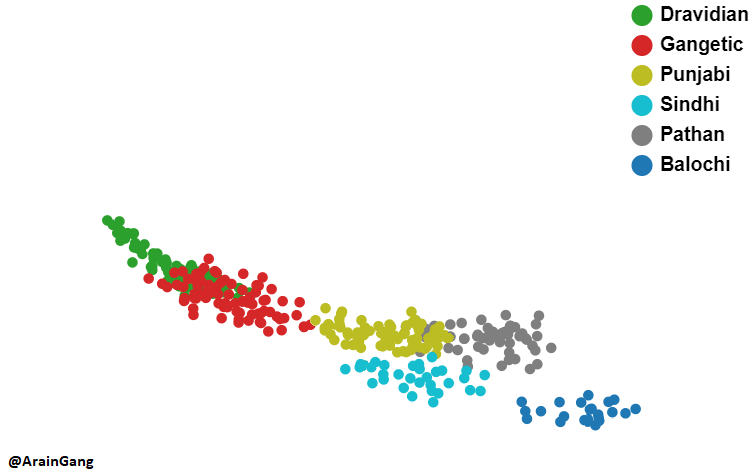
One such case I want to highlight is the genetic gap between two neighboring Indo-Aryan regions; the Indus Valley (specifically Punjab and Sindh), and Gangetic North India (Uttar Pradesh, Rajasthan, Gujarat). Below is a PCA chart constructed from Harappa ancestry samples, which will help us visualize the genetic distance between these ethnic groups.

 
As can be seen from the figure above, there is little genetic overlap between the Indus Valley and Gangetic North India. In contrast, despite both a linguistic and geographic divide, Gangetic North India does exhibit significant overlap with Dravidian South India. Indus Punjabis show a similar relationship with Iranic Pathans, however Indus Sindhis and Iranic Balochis do not seem to overlap.

Hopefully this will help caution readers against lumping all Indo-Aryan ethnic groups together. These populations not only have significant cultural differences, but from a genetic standpoint they can often diverge considerably.

Notes:
-
The Dravidian sample includes individuals from Kerala, Tamil Nadu, and Andhra Pradesh. The Gangetic sample includes individuals from Uttar Pradesh, Rajasthan, and Gujarat. The Punjabi sample includes both Pakistani and Indian Punjabis. The Pathan sample includes individuals from the Eastern Pashtun grouping.
- Its possible that many of these groups will demonstrate greater or lesser genetic overlap once more South Asian genetic samples become available. This post is not the last word on the topic, simply an observation.
- The phenomenon of linguistically similar Indian groups diverging significantly from a genetic standpoint (even after adjusting for caste) is also seen with Malayalis visa-vis Dravidians, and Marathis visa-vis Indo-Aryans. Time permitting, I hope to write about both of these cases.
- Data source comes from Harappa Ancestry Project, with scores from individuals being largely collated from forums like Anthrogenica. This info is publicly available, and analysis can be reproduced by anyone willing to collate the scores and run them through a PCA program. I used BioVinci, but there are free programs available as well.

Tuesday, March 30, 2021

1971 War - Myths and Realities 1971

 A compilation of quotes from books refuting common myths about the 1971 war and it's predeceasing events.

Byline: Arshi Saleem Hashmi

December 16 1971 does not bring good memories for Pakistanis; it is the date we lost half of our country. Since 1971 a lot has been published questions have been raised politician and military personalities have been blamed and that continues to happen even today. According to the Hamood-ur-Rehman commission report the defeat suffered was not a result of military factors alone but had been brought about as the cumulative result of political developments that took place between 1947 and 1971. It is unfortunate that instead of an objective analysis of the circumstances that led to the debacle in 1971 one sided accusative approach is adopted to describe the situation during that time. Critiques of Pakistan take no time to come up with the accusation of brutality" being conducted by Pakistan Army without any substantiated data.

A strong narrative based on 'biased propaganda' was promoted without analyzing factors like the role of India Mukti Bahini Awami League and wrong decisions at political level. Unfortunately Bangladeshi youth is also being brought up on this narrative. East Pakistan was not governed properly can be a true assessment but the violence that was unleashed in the year prior to the secession was way too exaggerated. The brutal murder of innocent Bengalis was all classified as the gruesome act of Pakistan Military it actually helped covering the negligence of East Pakistani political and civil administration. The new narrative that was created in the subsequent years was to protect the violence conducted by Mukti Bahini and Awami League's members against those East Pakistanis who were not convinced that the solution to governance problems in East Pakistan was to break away from West Pakistan. 

These patriotic East Pakistanis believed in Pakistan and paid heavy price by losing their lives and damage to property. Later on all the killings were termed as genocide by West Pakistan's policy tool and Pakistan Army was presented as the one responsible for this.

Recently I have gone through few books that record the accounts of primary sources and show the true picture. These books in a way respond to the most prevailing myths about 1971 and East Pakistan. The study of these books reveals the extent and effectiveness of Indian and Awami League propaganda to defame Pakistan and Pakistan Army. These independent scholars who have tried to bring a more scholarly work based on extensive research included personal experience as well as accounts of common Bangladeshis to unravel the true face of negative narratives.

Sarmila Bose is one such author who in her book Dead Reckoning: Memories of the 1971 Bangladesh War" provides primary sources interviews detailing the accounts during the time and unfolding many mysteries that have been dominating the literature on East Pakistan situation.

There are many other voices opening up new avenues for researchers and scholars working on Bangladeshi politics and its history. Ikram Sehgal renowned defence expert has come up with his book Escape from Oblivion: The story of a Pakistani Prisoner of War in India". Mr. Sehgal narrates the details about the real situation after Pakistan Army men were taken as prisoners by India.

Similarly the book The Wastes of Time: Reflections on the Decline and Fall of East Pakistan" written by a Bengali professor Dr Syed Sajjad Hussain who remained Vice Chancellor of Rajshahi University and moved to Dhaka University in July 1971 gives an insider's account that unfolds many secrets regarding East Pakistan buried in the history.

In next paragraphs I am reproducing few of the relevant excerpts for the interest of readers that also highlight different but a well-researched view-point about prevailing myths.

Myth: The military operation was conducted against innocent civilians.

Reality: "At the more organised level weapons training started and military-style parades were held carrying weapons both real and dummy. Kaliranjan Shil a Communist activist who survived the army's assault on Jagannath Hall in Dhaka University on 25-26 March wrote that following the postponement of the national assembly on 1 March and the start of the non-cooperation movement as part of the struggle the student union started 'training in pre-paration for war with dummy rifles on the Dhaka University gymnasium field... I was also taking training in a group. In a few days our first batch's training was completed and along with girl-students' group three groups of us took part in a march-past on the roads'. Photographs of marching girls carrying rifles appeared in the foreign media during this period and images of such gatherings and parades are displayed with pride in the Liberation War Museum in Dhaka. 

 The invocation of Gandhi's name in connection with the Bengali uprising of 1971 is not only entirely inappropriate it is patently absurd. Mujib 'the apostle of agitation' seeking power through brilliant oratory and electoral politics did not speak the language of Gandhi or think his thoughts. Crowds did not go to hear Gandhi armed with guns rods and spears." (Sarmila Bose Dead Reckoning: Memories of 1971 Bangladesh War Page 26)

Myth: There were over 3 million killings of Bengalis during the military operations.

Reality: "Examination of the available material on the 1971 war in both Bengali and English showed that while the allegation of 'genocide' of 'three million Bengalis' is often made in books articles newspapers films and websites it is not based on any accounting or survey on the ground. Sisson and Rose state that the figure of three million dead was put out by India while some Bangladeshi sources say it was the figure announced on his return to Dhaka by Sheikh Mujib who in turn had been 'told' that was the death toll when he emerged from nine months in prison in West Pakistan. It is unclear who 'told' Sheikh Mujib this and on what basis. However Sheikh Mujib's public announcement of 'three million dead' after his return to the newly created Bangladesh was reported in the media.

For instance on 11 January 1972 in The Times Peter Hazelhurst reported from Dhaka on Mujib's emotional home-coming: in his first public rally in independent Bangladesh Mujib is reported to have said 'I discovered that they had killed three million of my people'." As the earlier chapters indicate my own experience in Bangladesh was very similar with claims of dead in various incidents wildly exceeding anything that could be reasonably supported by evidence on the ground. 'Killing fields' and mass graves were claimed to be everywhere but none was forensically exhumed and examined in a transparent manner not even the one in Dhaka University. Moreover as Drummond pointed out in 1972 the finding of someone's remains cannot clarify unless scientifically demonstrated whether the person was Bengali or non-Bengali combatant or non-combatant whether death took place in the 1971 war or whether it was caused by the Pakistan Army.

Ironically as Drummond also points out the Pakistan Army did kill but the Bangladeshi claims were 'blown wholly out of proportion' undermining their credibility. Drummond reported that field investigations by the Home Ministry of Bangladesh in 1972 had turned up about 2000 complaints of deaths at the hands of the Pakistan Army." (Sarmila Bose Dead Reckoning: Memories of 1971 Bangladesh War Pages 175 177)

Myth: The riches of East Pakistan (Sonar Bangla) were exploited by West Pakistanis.

Reality: "The second move in the game was to build up an equally fictitious image of a Bengal overflowing with milk and honey which had been delivered over to Pakistan. The so-called Bengali scholars claimed to discover almost every day more and more evidence of a rich cultural heritage in Bengal's past now exposed to risk. The fact that the province had not yet recovered from the devastating famine of 1943 and the ravages of the Second World War was conveniently overlooked. Nor did anybody care to draw. attention to the recurring cycle of famines and shortages which has been a constant in Bengal's history. Only about 43 years before the 1943 famine there had been at the turn of the century a terrible famine of the same kind which had taken a heavy toll of human life. Stories of similar food shortages at twenty-five or fifty year intervals form the staple of Bengal's literature. But the illiterate public in Bengal have a short memory and are apt to forget inconvenient truths.

They love day-dreaming. Oblivious to the picture of this barrenness and starvation the image they love to cherish of Bengal is that of an inexhaustible granary where no one goes hungry"... No one could deny either openly or secretly that Bengal overwhelmed with a large population needed foreign capital for development since she had no capital herself. On the other hand the presence of outsiders who seemed to possess both money and skill was keenly resented. To rationalise the resentment they created the myth that the outsiders were not really helping in the development of her resources but fleecing Bengal. There had existed they maintained back in the dim past of Sonar Bangla a Golden period when the country lacked nothing. The outsiders had eaten her resources away reduced her to destitution and poverty and degraded her to her present position. The myth took hold on the imagination of the public.

In their lucid moments of course they remembered how relentless the realities around them were. But the natural bent of their minds towards romanticism and emotionalism gave rise to puerile fancies without the slightest foundation in fact about the wealth and resources of the motherland. The Indian conspirators kept fanning this puerilism taking advantage of the inevitable frictions which the advent of foreign capital produces in any society." (Dr Syed Sajjad Hussain The Wastes of Time: Reflections on the Decline and Fall of East Pakistan Pages 111 112 117)

Myth: Pakistan Army alone is responsible for all violence.

Reality: By the time I reached my unit my world had been turned topsy-turvy the writing clearly on the wall. One could never believe that the 2E Bengal had killed their West Pakistani colleagues. Sadly it was true. The massacre of the family of Subedar Ayub was especially heinous and unforgiveable. All these officers had repeatedly been warned by West Pakistani officers that they would be killed if they did not leave the unit. During those critical days some Bengali officers even advised them to take leave or go to Dacca on some pretext. All of them without exception refused to take the easy exit by abandoning the unit. It was unthinkable on their part to do so particularly at such a juncture. They all were of the sentiment that if they stood their ground they will be able to stop any action that might be taken against their unit. But they proved to be gravely wrong. They were murdered their martyrdom proves that they were heroes by all means.

Their killing is a dark stain on history and can never obliterate the fact that they were a fine battalion." (Ikram Sehgal Escape from Oblivion: the Story of a Pakistani Prisoner of War in India Page 6)

Myth: India entered the war in December 1971 and was trying for peaceful political solution to the problem from the outset.

Reality: The date of the start of full-fledged war between India and Pakistan in 1971 is a contested issue. The date popularly given out is 3 December the one announced by India but this is merely the date the war spread to include the Western sector. In a sense India's involvement in the war may be taken to be from March and its involvement in the politics of the province perhaps from even earlier. Numerous Bangladeshi pro-liberation accounts blithely recount close contact and coordination with authorities prior to the military action taken by the Pakistani Regime as well as in-year. Many of the Pakistani officers I spoke to described Indian involvement and casualties in 'actions' in East Pakistan throughout the year

'The big operations are always done by the Indians' reported The Guardian on 18 September 1971 after an ethnic Bengali who blended in with the local population and needed no translation visited the training camps of the Mukti Bahini in India and crossed in to East Pakistan with a guide on his own. Of the couple of hundred Bengali 'volunteers' who were said to be in the border area he visited only six had been given any training at all and only three had taken part in any operation" The American government was correct in its assessment that India had already decided to launch a military operation in East Pakistan when Mrs. Gandhi came to Washington in early November pretending that she was still seeking a peaceful solution". (Sarmila Bose Dead Reckoning: Memories of 1971 Bangladesh War Pages 172 173)

Myth: The West Pakistanis imposed their culture on Bengalis.

Reality: During the Civil War of 1971 there was a great deal of talk in the American Press particularly in such journals as Time and Newsweek about the revolt of the Bengalis against the attempted imposition of an alien culture upon them by the Punjabis. In so far as the term Bengalis connoted Bengali Muslims this was of course a plain lie there having been no difference between the culture of one section of Muslims and another in Pakistan. In so far as the statement referred to the original culture of the local inhabitants there was not much in it which one could consider worth defending. There was in either case no truth in the allegation that the inhabitants of East Pakistan were being forced to accept a way of life repugnant to them.

What had indeed been happening since the adoption of policy of industrialisation by Pakistan was that the crust of old customs and superstitions was gradually breaking up people were beginning to understand the advantages of modern comforts; polished floors were being substituted for mud and sand bamboo being replaced by cement concrete porcelain taking the place of brass and bell-metal chairs and tables being substituted for cane mattresses. New roads better communications the influx of capital from abroad the growth of industrial townships the arrival of new skills and techniques had begun to erode the traditional pattern of life and end the old isolationism. An air of cosmopolitanism filled the atmosphere. Bengalis both Hindus and Muslims were being forced increasingly to come into contact with foreigners whose ways and judgments were so different.

The opening of airports in remote areas like Lalmonirhat or Shaistanager the setting up of a paper mill at Chandraghona or a newsprint mill at Khulna the establishment of a network of jute mills all over the province the discovery and utilisation of gas at Haripur and Titas disclosed new potentialities at the same time that they opened up possibilities of change never foreseen." (Dr Syed Sajjad Hussain The Wastes of Time: Reflections on the Decline and Fall of East Pakistan Page 116)

Myth: West Pakistani Army was the 'occupying force' whereas Indian Army was a 'liberation army'.

Reality: "The Pakistan army is also constantly referred to in the Bangladeshi literature as an occupying force' or 'hanadar bahini' (invading force raiders). This is a mindless misrepresentation of reality. In 1971 East Pakistan was a province of Pakistan a country created in 1947 as a homeland for South Asia's Muslims through a movement in which East Bengal played a significant role. The Pakistan army was present in the province as it was in other provinces of the newly created state. Bengalis served both in the existing units of the army and in the special Bengal regiments raised later. Just as West Pakistanis served in East Pakistan Bengali officers were posted in West Pakistan.

Bengalis who later decided they wanted to secede from Pakistan and fight for an independent country could have termed the Pakistan army 'shotru' 'enemy forces' whom they wished to eject instead of resorting to pointless attempts to erase history by labelling them 'occupying' or 'invading' forces as though they had suddenly appeared from a foreign land. Moreover many Bengalis did not support the idea of secession and continued to consider the Pakistan regime the legitimate government and some Bengali officers continued to serve in the Pakistan army defending what was still Pakistani territory. There was only one 'invading force' in East Pakistan in 1971 that was India." (Sarmila Bose Dead Reckoning: Memories of 1971 Bangladesh War Page 163)

Myth: Bengali language was fundamental part of Bengali nationalism.

Reality: "The Indians began by painting a dismal picture of the subservience to which the Bengali-speaking Muslims of East Pakistan would be reduced in the event of Urdu being declared Pakistan's state language. The Bengali-speaking Hindus of West Bengal saw no threat to their identity in the adoption of Hindi as the Indian state language. This was perverse logic. We seemed to be back in the world of Humpty Dumpty. But the so-called intellectuals of East Pakistan failed to see through the Indian game and immediately took up the cry that Bengali had to be saved from the threatened onslaught. A myth was concocted almost overnight about a conspiracy against the Bengali language" What on the contrary the Awami Leaguers assisted by the left-wing journalists fanned all the time was the cult of Bengali nationalism. Here again their dishonesty was transparently plain.

They didn't contend that the entire subcontinent needed reorganising on linguistic lines or that each major language group in Pakistan and India called for recognition as a separate nationality with a right to self-determination. The theory was applied to the Bengalis of Pakistan only. The Bengalis in West Bengal in India could stay where they were; the Marathis the Tamils the Andhras---all belonged to the Indian nation and nothing illogical could be seen in their union into a single State of the disparate language groups which inhabited India. The Nagas ethnically linguistically and culturally differed from the rest of India but they received no support although they had been struggling for secession since 1947; their leader Dr Phizo lived in exile in London while Indian tanks armoured cars heavy artillery and bombs helped 'pacify' Naga villages. The disputed area of Kashmir was also left severely alone.

No India had a right to be one and anyone who pleaded for pluralism either politically or culturally was a reactionary. But Pakistan with precisely the same demographic composition as India had to be viewed differently. Never in political history before has the jaundiced eye been so powerfully at work as in India and Pakistan weighing the same problems in the two countries in different scales and insisting on different conclusion." (Dr Syed Sajjad Hussain The Wastes of Time: Reflections on the Decline and Fall of East Pakistan Pages 111 213)

Myth: Armed activities against non-Bengalis were carried out by Mukti Bahini guerrilla only and not the Indian Army.

Reality: "Bengali accounts of the 'heroic' exploits of rebel fighter in the war are punctured by some accounts given by their powerful allies the Indians. 'It can now be said' wrote Maj. Gen. Sukhwant Singh 'that despite the Awami League's hold on the Bengali troops in the name of patriotism Mujib's charisma and the professional contacts in the armed forces of Col Osmani the organizers of the insurgency had not been able to draw up and implement an integrated plan... the revolt had no strong popular base'. Initially the Indian Border Security Force (BSF) supported the operations of the rebels but 'Unfortunately these efforts were not very effective'. 'The failure of the revolt and the poor results obtained by the rebel forces in their operations after crossing into India led to a detailed appraisal of the situation by the Indian Government in the last week of April'. According to Maj. Gen. Singh 'the Indian Army was asked to take over the guidance of all aspects of guerilla warfare on 30 April'"

The assessment of Maj. Gen. Lachhman Singh was similar: 'The Mukti Bahini fighter was not a dedicated guerilla... the Awami League leaders were reluctant to join them and face the hazards of military struggle. The guerillas had no safe bases for operations inside East Pakistan but could safely operate from camps across the Indian border'. In Singh's view 'It was becoming clear by July that Mukti Bahini was unable to win the confidence of the villagers'. They also avoided direct confrontation with the Pakistan army owing to the heavy casualties they suffered. However 'The propaganda machine worked hard and to good effect. Dressed in a Iungi and rifle in hand the Mukti Bahini guerilla became an instant hero... The news-hungry press swallowed claims of fictitious successes which were widely believed." (Sarmila Bose Dead Reckoning: Memories of 1971 Bangladesh War Pages 146-47)

Myth: Pakistani soldiers carried out rapes of university student during Operation Searchlight.

Reality: "None of the Bengali eye-witness accounts nor the testimony to me of Pakistan army officers involved in the action nor the evidence of the recorded radio communication among them mention Rokeya Hall the women's hostel of Dhaka University as a target of military action. Yet a story had circulated in 1971 repeated to me by members of the Bangladeshi intelligentsia about the women's hostel being attacked and girls jumping out of the windows. In reality like the other hostels Rokeya Hall had also emptied of its normal residents before 25 March and did not seem to have been a targeted building. Similarly as attested in Jahanara Imam's book by a terrified resident of Mohsin Hall the army did not go to Mohsin Hall either." (Sarmila Bose Dead Reckoning: Memories of 1971 Bangladesh War Page 57)

Myth: 93000 Pakistani soldiers became POWs to India.

Reality: "One of the most notable 'numbers' of 1971 in circulation is the assertion that '93000 Pakistani soldiers' were taken prisoner by India at the end of the war. This statement has been repeated virtually unchallenged in practically every form of publication. It is a number about which one expects a certain precision after all the number of POWs in India had to be an exact figure not an approximation. Yet it turns out that 93000 soldiers were not in fact taken prisoner.

In March 1971 the number of West Pakistani troops in East Pakistan was reported to be 12000. More forces were brought in to cope with the crisis and Lt Gen A. A. K. Niazi Commander of the Eastern Command in 1971 from April to December wrote: 'The total fighting strength available to me was forty-five thousand 34000 from the army plus 11000 from CAF and West Pakistan civilian police and armed non-combatants'. Out of the 34000 regular troops 23000 were infantry the rest being armour artillery engineers signals and other ancillary units.

How did 34000 army personnel plus 11000 civilian police and other armed personnel a total of 45000 men more than double into '93000 soldiers' who were reported taken prisoner by India in December" (Sarmila Bose Dead Reckoning: Memories of 1971 Bangladesh War Page 174)


Sunday, February 21, 2021

Debunking the 3 million genocide myth


This is copied from the "Ancient Pakistan" page on Facebook.

Just days after the Fall of Dhaka, General Abdul Siddigui and his Bengali nationalist guerrilla fighters (Mukti Bahini) are photographed using bayonets to torture and kill four Bihari men suspected of "collaborating" with Pakistan. This scene was repeated across Bangladesh weeks after 16 December 1971, in which minority communities like Biharis, Chakma Buddhists and even a small Punjabi community in Dhaka, were brutally murdered.

Mature nations should be able to question their own history, and accept interpretations which may differ from the one they were led to believe. This is particularly true in cases of conflict. As time passes and cooler heads prevail, we can start piecing together the facts, and shunning away the propaganda and exaggerations. History cannot be changed, but it can be reassessed.

I, as a historian and a Pakistani, personally hold no grudges against Bangladesh today nor am I interested in “reclaiming” East Pakistan. But the truth of 1971 must be told – ever since then, Pakistanis have been led to believe a masochistic version of history that holds us responsible for everything that happened in that war. But the actual evidence and sequence of events tells us a very different story, one which morally bankrupt pseudo-historians and cherry picking rights activists like Pakistan Votes and Brown History, would rather ignore.

The fact is non-Bengali minorities were brutally murdered by Bengali fascists. What exactly was the intention of targeting them is not fully understood, but a case of “ethnic cleansing” can surely be made. This is something the Government of Bangladesh (the Awami League in particular) would rather hide than accept, and to this day, the crimes committed against these minority communities by Bengali nationalists are either ridiculed or simply dismissed by the Awami League. It is particularly this reason why Bangladesh never made any efforts to involve the international community in going after and charging Pakistani generals involved in the 1971 war. Mujib knew very well that if an impartial, independent, international tribunal were to be set up, like the Nuremberg tribunal was after Nazi Germany fell, that the truth of their own war crimes against non-Bengalis would be exposed to the world.

But let’s take a step back for a second and go back to 1933, because this is an important fact that people seem to miss.

The fact is the conflict in East Pakistan should have never happened in the first place, because East Bengal was never meant to be part of Pakistan. This can be attested to the 1933 document “Now or Never”, written by Chaudhary Rehmat Ali, whereby he defines PAKSTAN, an acronym of the historic nations that would form the country in the future – meaning Punjab, Afghania (KP), Kashmir, Sindh and BalochisSTAN. Bengal was never in the picture to begin with, but in the hastiness of partition it appears the two Muslim wings were simply lumped together. Had our leaders had the foresight after 1947, East Bengal should have either become independent or become an autonomous territory within Pakistan.

There are three major issues why this should have occurred:

> Ethnolinguistic differences
East Bengal had a relatively homogenous ethnic population and spoke one language, whereas West Pakistan (comprising of Sindh, Balochistan, Punjab, Khyber Pakhtunkhwa, Jammu & Kashmir and Gilgit-Baltistan) was multiethnic, multilingual and multicultural.

> Population
East Bengal was overpopulated – roughly the size of Sindh, it had a larger population than all of West Pakistan’s provinces combined.

> Geography
East Bengal was an enclave surrounded on all four sides by India – its total border length with India was 4156 km, with an additional 270 kilometer border with Myanmar.

When all these factors highlighted, East Pakistan was simply a disaster waiting to happen.

Since this is a very long topic, I will divide it into four major parts:

Part 1: Debunking The 3 Million Myth
I have only used non-Pakistani sources from Bangladesh’s own Foreign Secretary to the British Medical Journal. Sources have been provided for each quote.

Part 2: Ethnic Cleansing by Mukti Bahini
The murder of Biharis is well known, but what is not known are the massacres committed against Chakma Buddhists in Chittagong Tract Hills and the small Punjabi business oriented community within Dhaka. With this in mind, the case of “ethnic cleansing” could surely be made.

Part 3: International Crimes Tribunals (Bangladesh)
This court was setup domestically within Bangladesh in 2012, based off the ICT Act which Bangladesh passed in 1973. The word “international” shouldn’t fool you, since the international community played no part in the trials. It was simply added in to look as if they did. Foreign observers have criticized the tribunal, mentioning government interference, restrictions on public discussion, not enough time allocated for the defence, the kidnapping of defence witnesses and a judge resigning due to controversy over his neutrality.

Part 4: What Pakistan Got Wrong In East Bengal
To suggest Pakistan had no role in the debacle of 1971 would be silly. This is why the Hamoodur Rahman Commission was setup to understand what led to the conflict of 1971. However, as you’re all well aware, it was classified at the behest of the military. The commission was highly critical of Pakistan's military interference in East Pakistan, misconduct of politicians as well as intelligence failures of the ISI and the Federal Investigation Agency (FIA).

~~~~~~~~~~~~~~~~~~~~~~~~~~~~
PART 1 - The Myth of 3 Million
I’ll start off by addressing the most controversial issue here – the myth that three million people were killed in East Pakistan by the army. This allegation was first made by Sheikh Mujibur Rahman on 8 January 1972. This number is widely circulated as fact, but sources from within Bangladesh seem to question its authenticity.

Serajur Rahman, a journalist and broadcaster with BBC Bangla Service at the time, wrote a piece in 2011 for The Guardian explaining how the three million figure came to be:

“On 8 January 1972 I was the first Bangladeshi to meet independence leader Sheikh Mujibur Rahman after his release from Pakistan. He was brought from Heathrow to Claridge's by the Indian high commissioner Apa Bhai Panth, and I arrived there almost immediately. Mujib was puzzled to be addressed as "your excellency" by Mr Panth. He was surprised, almost shocked, when I explained to him that Bangladesh had been liberated and he was elected president in his absence. Apparently he arrived in London under the impression that East Pakistanis had been granted the full regional autonomy for which he had been campaigning. During the day I and others gave him the full picture of the war. I explained that no accurate figure of the casualties was available but our estimate, based on information from various sources, was that up to "three lakh" (300,000) died in the conflict. To my surprise and horror he told David Frost later that "three millions of my people" were killed by the Pakistanis. Whether he mistranslated "lakh" as "million" or his confused state of mind was responsible I don't know, but many Bangladeshis still believe a figure of three million is unrealistic and incredible.” (Source: https://www.theguardian.com/world/2011/may/24/mujib-confusion-on-bangladeshi-deaths)

However, in the book “Sheikh Mujib: Triumph and Tragedy” by Sayyid A. Karim, Bangladesh’s first foreign secretary, he wrote a different story about the three million claim:

“As for the number of Bengalis killed in the course of the liberation war, the figure of 3 million mentioned by Mujib to David Frost in January 1972 was a gross overstatement. This figure was picked up by him from an article in Pravda, the organ of the communist party of the Soviet Union.” (Source: http://uplbooks.com.bd/author/sayyid-karim)

But where did Mujib get his hands on Pravda in London? That answer lies in an article written in “The Bangladesh Observer”, which was published on 5 January 1972 (and was a prosecution exhibit in the Golam Azam case) entitled, “Pak Army killed over 30 lakh people”. It reads:

“The Communist party news paper ‘pravda’ has reported that over 30 lakh persons were killed throughout Bangladesh by the Pakistan occupation forces during the last nine months, reports ENA. Quoting its special correspondent stationed in Dacca the paper said that the Pakistan Military forces immediately before their surrender to Mukti Bahinis and the Allied forces had killed about 800 intellectuals in the capital city of Bangladesh alone.”

It is unclear how Pravda got ahold of this figure – the newspaper simply quotes its special correspondent, which in turn is quoted by the Bangladesh Observer. It’s pertinent to note that the USSR played a big role in the secession of East Pakistan and riling up Bengalis. In a television interview, retired KGB Psychological Warfare Officer Yuri Bezmenov explains in detail how the USSR aided Mujib by using India. (Watch video here https://www.youtube.com/watch?v=7bb_fXONk2Y)

In 1974, Bangladesh apparently tried to calculate the number of people who had died in 1971. However, upon most of the study being completed, the actual number calculated came to around 250,000 dead and was nowhere close to the estimated 3,000,000 Mujib had claimed in 1972. Upon hearing the number, Mujib had the entire study shut down. Lawrence Lifschultz, a resident correspondent with the “Far Eastern Economic Review” in Bangladesh, wrote about this in detail:

“In the course of my reporting I met a very interesting man who had a very intriguing story to tell about the work he had recently been doing. He was employed by the Home Ministry and was part of a team of researchers conducting a study that was trying to assess the total number of casualties that had occurred during the nine months of 1971 as war raged across the country. The Home Ministry study was trying to assess how many people had died directly from the armed violence of the Pakistan Army and their local collaborators. They were also trying to estimate how many people had died on the road or once they reached refugee camps across the border in India. Many of these deaths were among children and the elderly. The study was conducted by field workers systematically asking families in villages about those who had died from their village during the war and under what circumstances. They were slowly building up a picture across the country. At the time we met, the Home Ministry team had completed their survey in approximately a third of the districts. My Home Ministry source told me that based on their projections the number of deaths from the war was estimated at 250,000 people. As I recall, this did not include the young, the ill and the elderly, who died either in the refugee camps or as they fled the Pakistan Army. A quarter of million people dying from armed violence is by any measure a terrible and tragic number. However, according to my source, the study was abruptly shut down and discontinued. The reason was that the survey was moving toward a statistical conclusion that differed with the prevailing orthodoxy that three million people had died from armed violence and refugee migration. (Source: http://www.pamphleteerspress.com/the-case-of-david-bergman)

And the controversy continues to this day. Bangladesh Nationalist Party (BNP) chief and former Prime Minister of Bangladesh Khaleda Zia herself has questioned the validity of the three million claim:

“There is a debate about how many hundreds of thousands were martyred in the Liberation War. Different books and documents give different accounts.” (Source: https://www.thehindu.com/news/international/khaleda-raises-doubt-on-liberation-war-casualties/article8018812.ece)

In Volume 30 of the “Population Studies: A Journal of Demography” published in 1976, the study ”Demographic crisis: The impact of the Bangladesh civil war (1971)” estimates around 500,000 deaths during the conflict. (Source: https://www.tandfonline.com/doi/abs/10.1080/00324728.1976.10412722?tab=permissions&scroll=top)

In the British Medical Journal’s 2008 volume, the study “Fifty years of violent war deaths from Vietnam to Bosnia: analysis of data from the world health survey programme” states around 269,000 deaths (allowing a possible range of 125,000 to 505,000). Earlier estimates of casualties during the Bangladesh war were in the region of 58,000, the study noted. The objective of the survey was to provide an accurate estimate of deaths in wars. The study analysed estimated deaths from war injuries in 13 countries over 50 years, including Bangladesh and Sri Lanka. (Source: https://www.bmj.com/content/336/7659/1482)

Despite factual evidence available from non-Pakistani sources debunking the myth of 3 million, some Bangladeshis, and many Indians for that matter, continue to believe this ridiculous number. M. A. Hasan, convener of the "War Crimes Fact Finding Committee" in Bangladesh says that:

“The figure of liberation war martyrs is one such issue which no one should question.”

The fact this is coming from somebody who heads a “Fact Finding Committee” is quite disturbing. It’s evident from this quote that fact finding is not the objective here, but rather cementing the myth is. Since the Awami League came to power again in 2009, it has tried to use the emotions surrounding the 1971 war to justify a move toward authoritarian one-party rule in Bangladesh. In its version of history, only the Awami League is the party of liberation, and therefore of government, and opposition parties are branded as “pro-Pakistan,” and therefore dangerous and disloyal. For many others however, both within and outside of Bangladesh, questions are indeed necessary on the 1971 war.

All of what has been written above comes in the form of small articles and studies. However, if you want an unbiased, scholarly take into the events surrounding 1971, I would suggest Sarmila Bose’s book “Dead Reckoning: Memories of Bangaldesh”.

Sarmila Bose is a British-Indian historian at Oxford who is credited for publishing the first scholarly analysis of the 1971 conflict. Bose’s investigation of the 1971 Bangladeshi narrative began when she saw a picture of the Jessore massacre of 2 April 1971. The caption of the photo stated: "April 2, 1971: Genocide by the Pakistan Occupation Force at Jessore". However, upon closer examination, Bose found that "some of the Jessore bodies were dressed in shalwar kameez an indication that they were either West Pakistanis or Biharis. In Bose's book, she has done a case-by-case body count estimate that lead her in the end to estimate that between 50,000 and 100,000 people were killed on all sides, including Bengalis, Biharis, West Pakistanis and others, in 1971 war. (s: https://www.theguardian.com/books/2011/jul/01/dead-reckoning-sarmila-bose-review) and (https://www.telegraphindia.com/culture/style/the-truth-about-the-jessore-massacre/cid/1553111)

Another book I suggest reading is by Dr. M. Abdul Mu’min Chowdhury, a Bengali nationalist who actively participated in the separatist cause. In his book "Behind the Myth of 3 Million", he challenges the falsehood and conspiracy theories around what took place in 1971. Citing an extensive range of sources to show that what the Pakistan Army was carrying out in East Pakistan was a limited counter-insurgency, not genocide, the scholar discloses that after the creation of Bangladesh, the new de facto government offered to pay 2000 Taka to every family that suffered loss of life, but only 3000 families claimed such compensation. Had there been three million Bengalis dead, a lot more families would have come forward. Furthermore, the actual fighting force of the army in East Pakistan was 40,000 not 93,000. As such, when India invaded East Pakistan, the army was at a 50:1 disadvantage. (http://www.storyofbangladesh.com/ebooks/myth-of-3-million.html#:~:text=Many%20myths%20have%20been%20formed,integrity%20of%20a%20united%20Pakistan.)

Other Sources
https://www.nytimes.com/2016/04/06/opinion/the-politics-of-bangladeshs-genocide-debate.html

http://bangladeshwarcrimes.blogspot.com/2014/02/1971s-war-time-dead-further-thoughts.html